연구 분야

Research

지능형 영상처리, 엣지 컴퓨팅, 확장현실(XR) 세 축으로 연구를 진행합니다.

Intelligent Signal Processing

Multi-channel 1D Biomedical Signal Processing

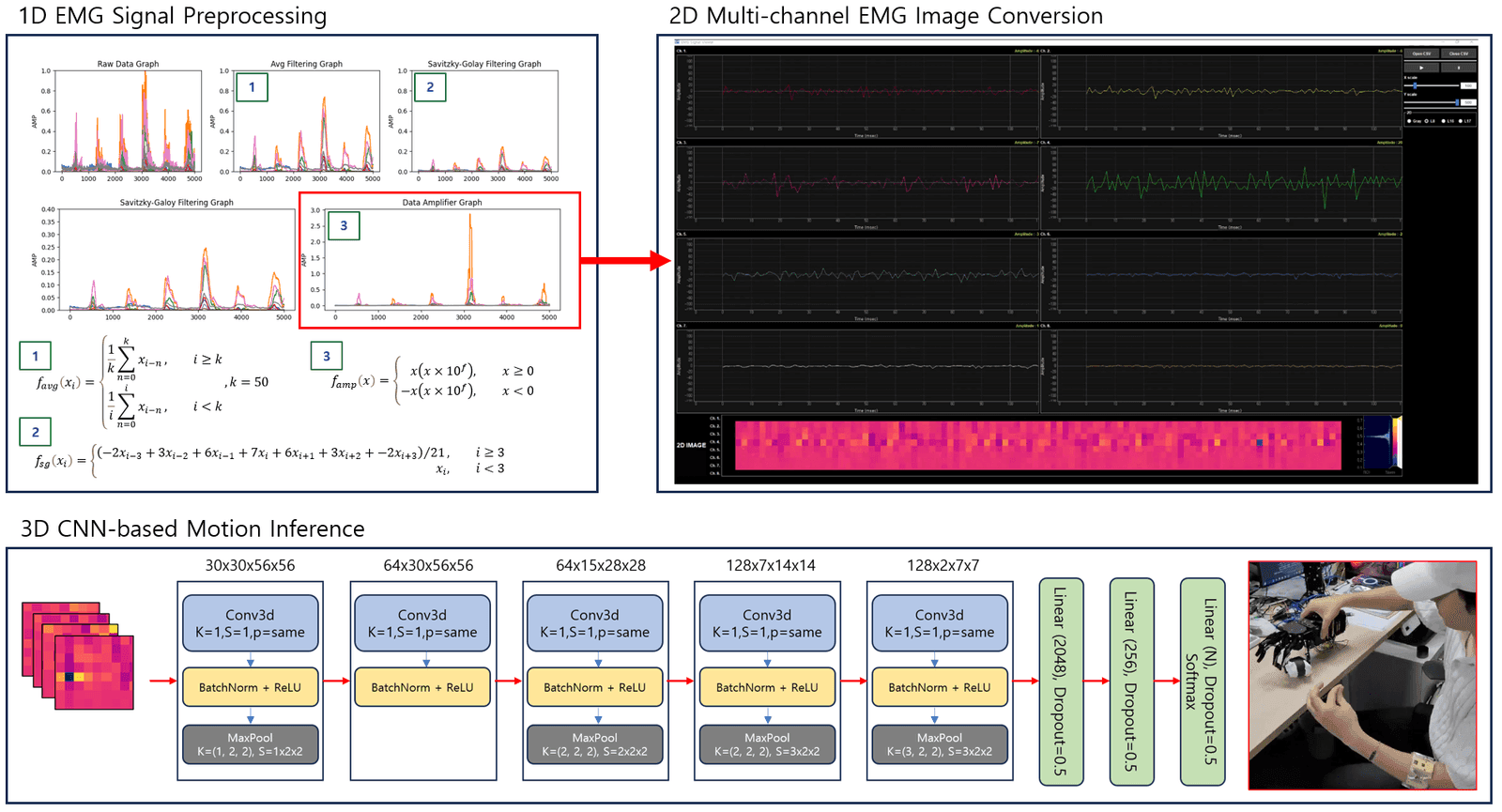
  • Apply an average filter that averages the signal value for primary noise removal. i is the index number of the input signal, x is the input signal, and k is the length of the filter (Formula 1).
  • Determine the length of the filter according to the sampling rate of the biosignal.
  • Apply a Savitzky-Golay filter to remove noise and maintain the peak value of the signal (Formula 2).
  • Based on a sampling rate of 10,000 Hz, an average of approximately 0.0034 ns of computation is required when adding the filter.
  • Post-processing the signal amplification as the intensity of the signal data decreases due to the double noise removal filter. The signal is amplified, but the static signal part is maintained at a relatively low signal value, and the result of the dynamic signal part being amplified is confirmed (Formula 3).
  • Real-time signal processing is possible by requiring a small computational cost with a simple formula.
  • Reduce the size of the sensor and device by amplifying with software rather than a circuit-configured amplification.
  • Real-time conversion of acquired signals or noise-removed and amplified signals into 2D image data.
  • The accuracy standard is set to the degree of time series consistency between actual and predicted motions. Achieved an average accuracy of 92.41%.
  • Expanding the universality of research results through robot linkage.
Multi-channel 1D Biomedical Signal Processing

Pose Estimation

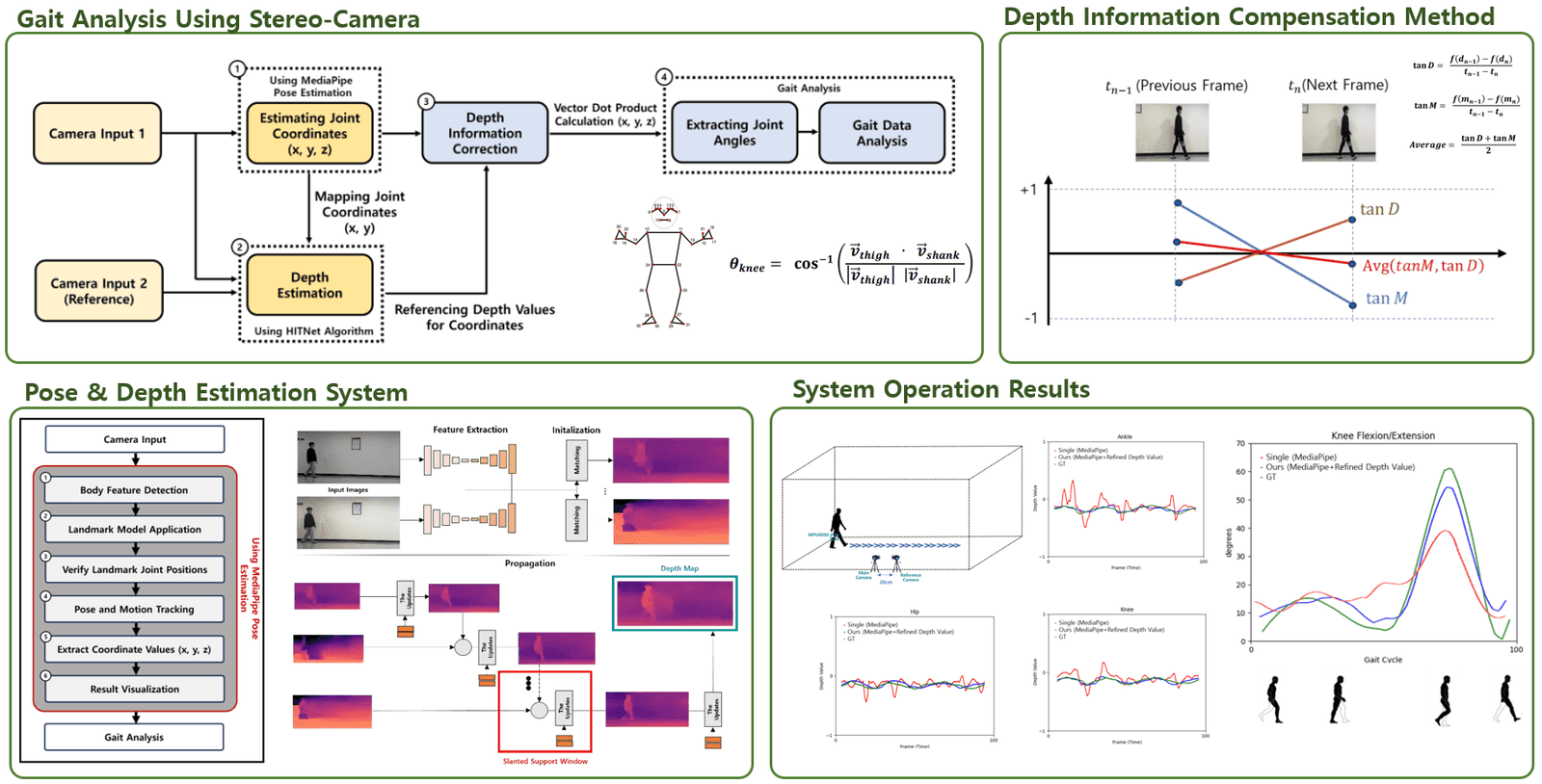
  • Using two RGB camera systems, capture walking motion images from two different angles, apply a binocular depth inference algorithm to extract depth information to analyze walking motion in three dimensions, and use pose estimation to precisely analyze walking by referencing the depth value of the corresponding joint position.
  • Perform body pose estimation to map the x, y value coordinates for each image frame to the depth map, extract the depth value of the corresponding joint keypoint, and then perform z value correction according to the change in the gap value.
  • In the system that applies the z-coordinate depth value of the joint position inference model and the refined depth value based on stereo vision, perform an average operation on the depth value according to the flow of time for each system to reduce the error between each estimation model.
  • Extract ground truth for each joint by constraining a total of 14 6-axis IMU sensors, including limb joints and hip joints, to the inference target joint location. The deep learning model implemented through this study achieved an average position inference accuracy of 96.31% in real-time (90fps) images.
Pose Estimation

AI Medical Assessment

  • The objective of this study is to improve the accuracy of learning models for assessing pressure injuries.
  • The PI (Pressure injuries) dataset was insufficient and inconsistently proportioned by class. Therefore, the dataset required for model training needed to be increased.
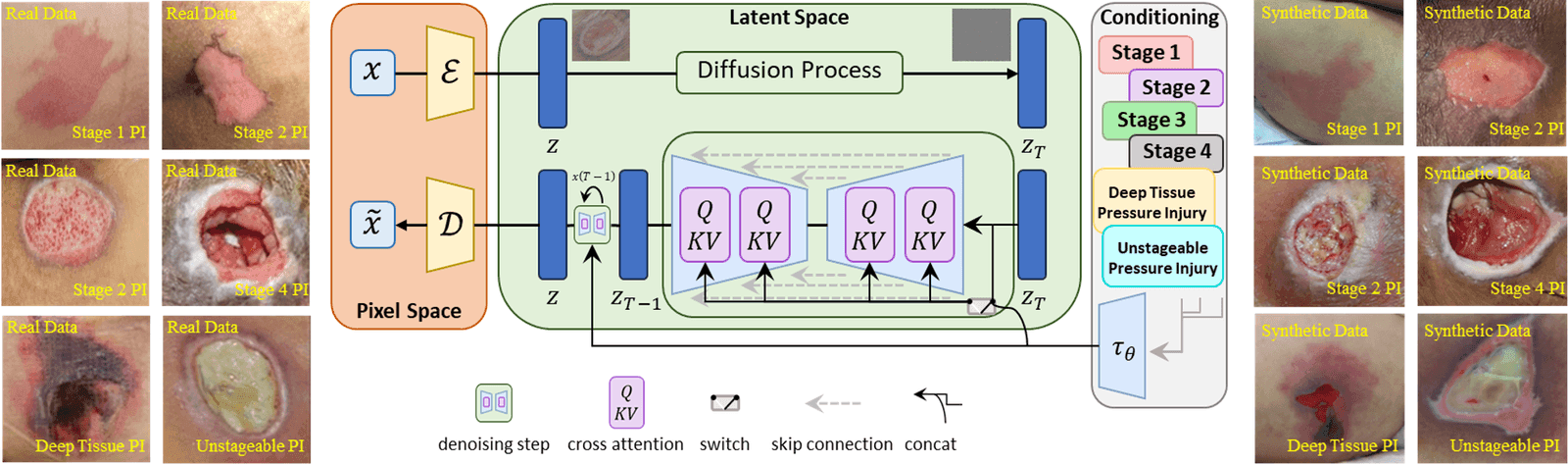
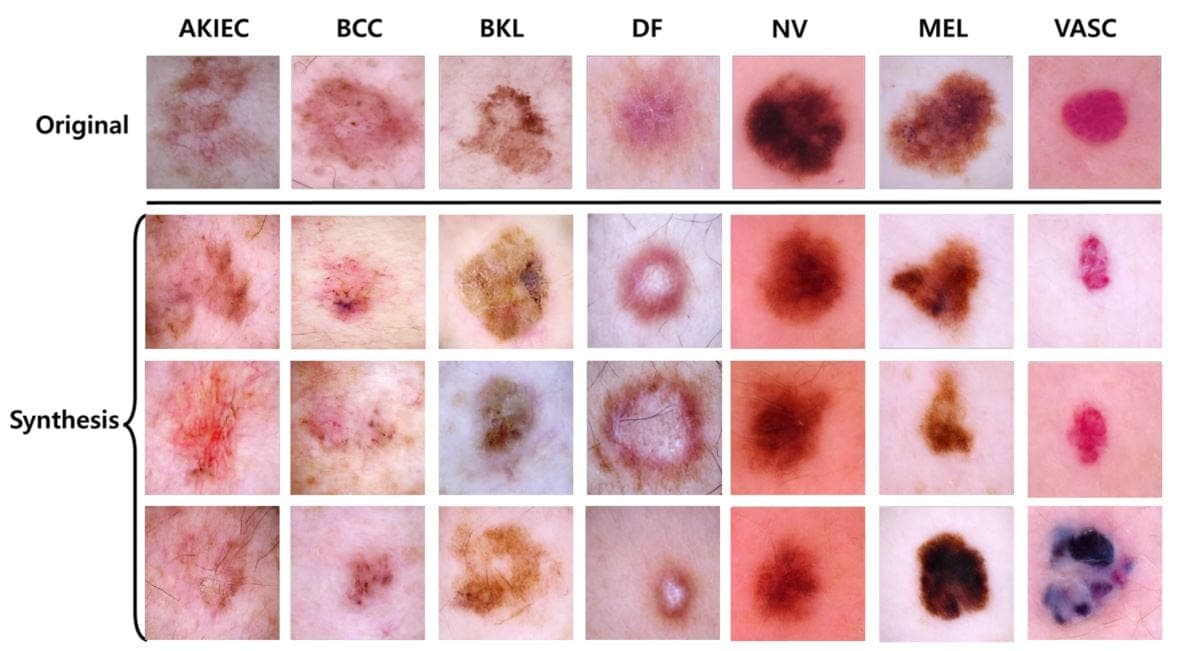
  • Synthetic data generation is essential for addressing imbalances in the PI dataset and improving the generalization performance of the model. We generated synthetic data using a stable diffusion-based generative AI model.
  • The stable diffusion model’s overall process involves compressing the input images using an encoder module. Subsequently, it progressively removes noise from the generated latent representations through a diffusion process in Latent Space, producing high-quality reconstructed images.
  • The diffusion process in Latent Space is divided into multiple stages (T stages), with each stage finely adjusting the latent representations. During this process, Self-Attention and Cross Attention modules are employed to learn various patterns and features of the PI images.
  • The stable diffusion model’s training objective is to minimize the difference between the predicted noise and the actual noise.
AI Medical Assessment

Non-Invasive Vital Signs Sensing and Monitoring

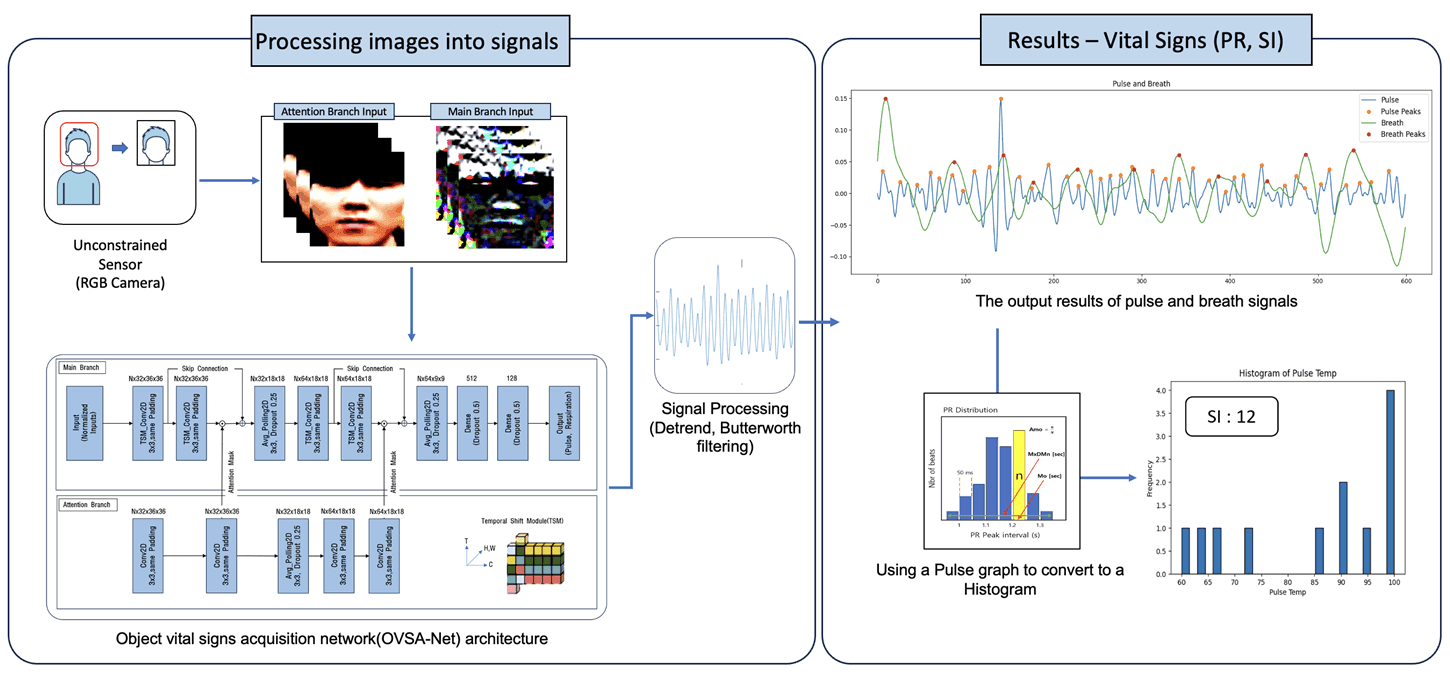
  • An end-to-end proposed process for acquiring and analyzing vital signs in an unconstrained, free state using a non-contact sensor (RGB camera), from data input to output.
  • Extract face data using a face extractor to isolate the face region (ROI) from the input video.
  • Construct a CNN model using TSM, MTAN, and Skip-connection to achieve low computation load, efficient time information analysis, and overcome noise interference.
  • Develop appropriate data preprocessing techniques to ensure effective learning when the data is input into the constructed CNN module.
  • Use Butterworth and Detrend methods to process the signals predicted through deep learning for signal analysis.
  • Develop a calculation formula to estimate heart rate and stress levels from the processed signal data.
Non-Invasive Vital Signs Sensing and Monitoring

Edge Computing

AIoT with Edge Hub

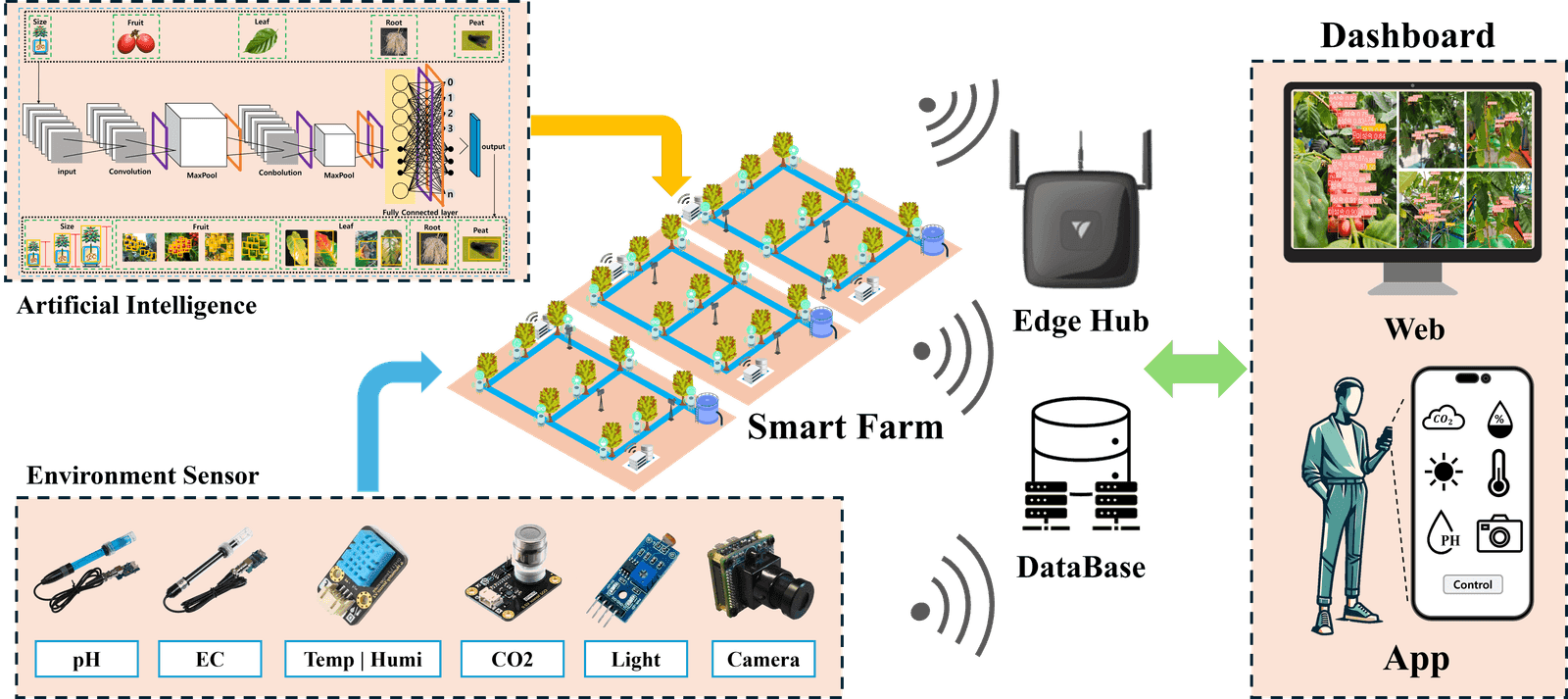
  • Combine image processing-based AI and IoT technologies to automatically detect crops, analyze growth, predict harvest timing, and measure fruit dimensions.
  • Enhance real-time monitoring capabilities by leveraging edge-fog computing to collect and analyze field environmental data and optimize sensor networks.
  • Build a decision-making system based on machine learning and deep learning to help identify optimal growing conditions and detect abnormalities early.
  • Realize reliable data-driven decision-making with integrated sensor data management and remote control capabilities.
  • Maximize operational efficiency with a cloud-based visualization platform that combines web dashboards and mobile apps.
AIoT with Edge Hub

Lightweighting for Embedded Systems

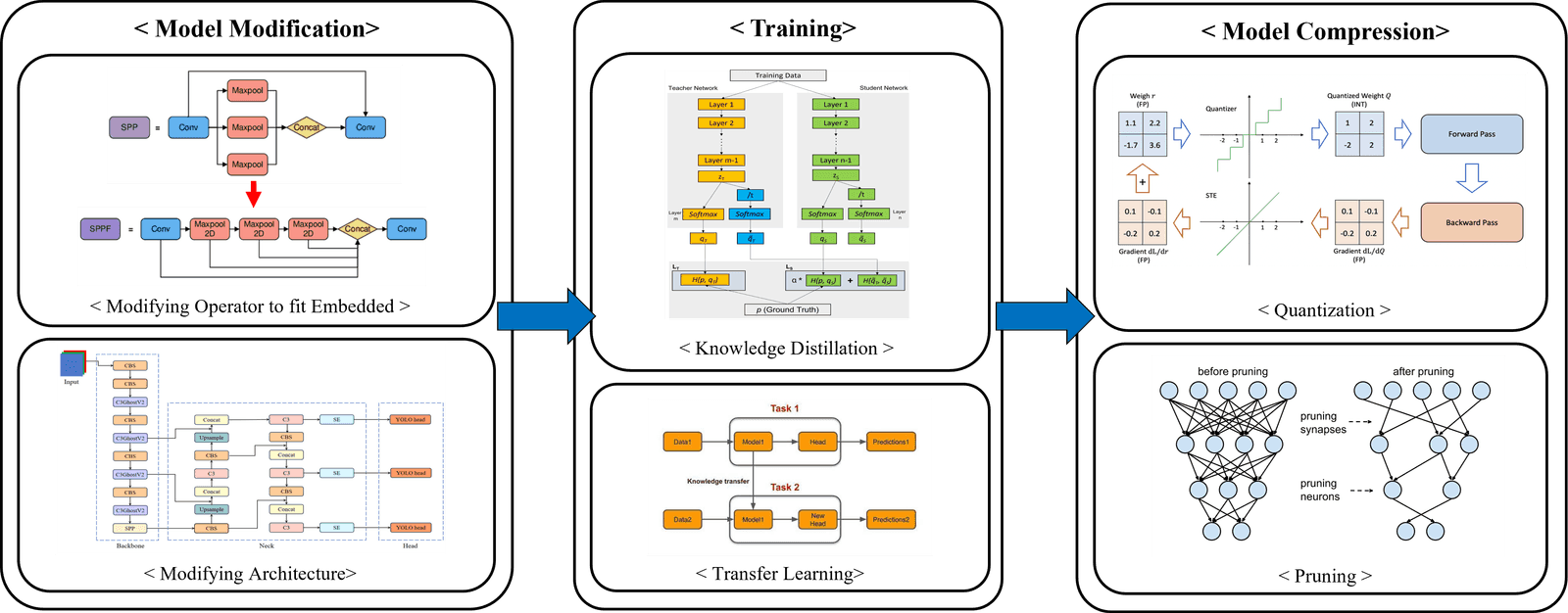
  • Model Modification: The operators and architecture are modified to fit embedded systems, enabling the implementation of an efficient model. This allows for optimization while considering the constraints of the system.
  • Training: Knowledge distillation and transfer learning techniques are used to improve model performance and enable efficient learning across various tasks.
  • Model Compression: Quantization and pruning techniques are applied to effectively reduce the model size and computational load, optimizing execution performance in embedded systems.
  • Embedded System Optimization: The optimized model is adjusted to fit the requirements of embedded systems, ensuring performance is maintained while minimizing resource consumption.
Lightweighting for Embedded Systems

Edge-Cloud Collaborative Intelligence

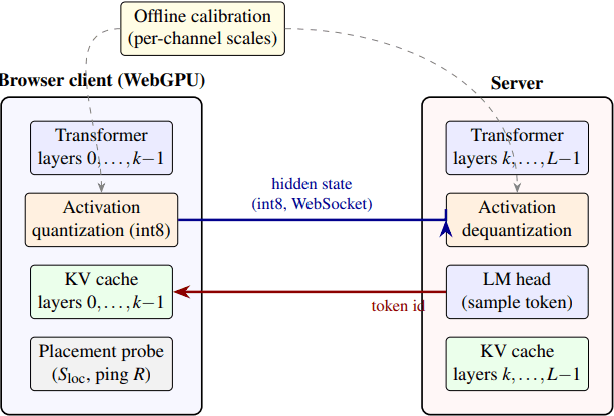
  • SplitLLM partitions autoregressive LLM inference between a WebGPU browser client and a remote server, so a model runs on the user device with zero installation while the heavy layers stay in the cloud.
  • The client executes transformer layers 0 to k-1 in the browser and sends the boundary hidden state; the server runs the remaining layers and the language-model head and returns the sampled token. A key-value cache is kept on both sides of the partition.
  • The transmitted activation is compressed to 8 bits with static, offline-calibrated per-channel scales that are shared with both endpoints before deployment, halving the payload while keeping WikiText-2 perplexity within 0-7% of full precision and transmitting no scale at runtime.
  • The optimal split point depends on the client device, whereas the per-token round trip is invariant to it - confirmed on a commercial 5G link - which supports a lightweight on-device placement rule that needs no trial offloading.
Edge-Cloud Collaborative Intelligence

eXtended Reality

XR Rehabilitation

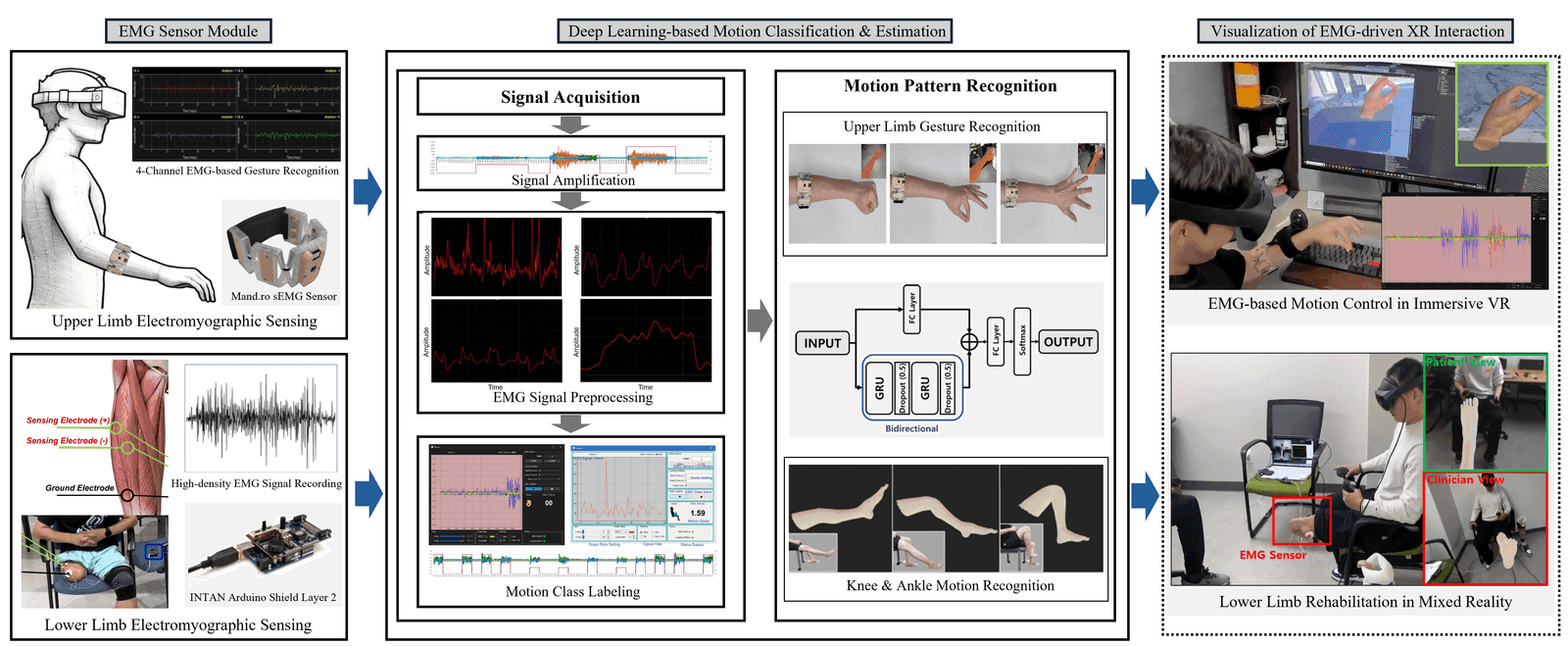
  • XR Rehabilitation developed by MR(Mixed Reality) system
  • It is a simulation that creates and attaches a virtual prosthetic leg on amputee’s leg in real-time
  • XR Rehabilitation performs EMG Signal Processing through Raspberry Pi to measure the patient’s EMG signal and is transmitted to Unity through TCP communication
  • XR rehabilitation can support non-face-to-face online services and can support face-to-face experience and immersion without physical constraint
XR Rehabilitation

Interactive XR Feedback

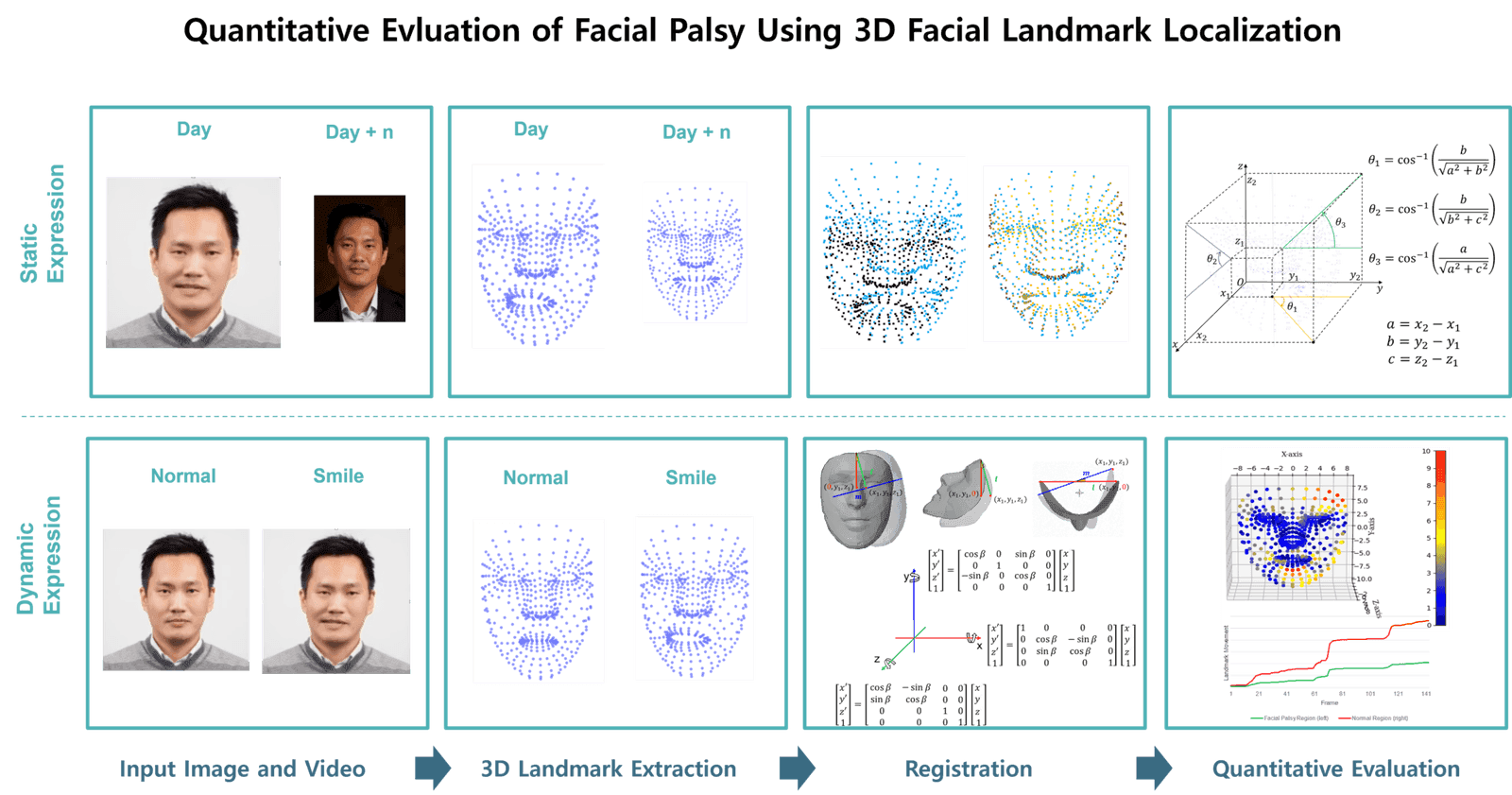
  • 478 3D facial landmarks (468 facial and 10 eye landmarks) are extracted from 2D RGB images, so a single camera yields three-dimensional facial geometry.
  • Landmarks captured at different times differ in scale, rotation, and position and cannot be compared directly. They are registered first by scale matching, then by global registration for a coarse alignment, and finally by point-to-plane ICP initialized with the transformation matrix from that alignment.
  • After registration, distance symmetry and angular symmetry give a numerical measure of left-right symmetry in a static expression.
  • For dynamic expressions, the amount of landmark movement compares the two sides of the face at the same instant.
Interactive XR Feedback

Eye (Gaze Estimation)

  • Improved Feature-based Gaze Estimation Using Self-Attention Module and Synthetic Eye Images
  • Estimates gaze by detecting eye region landmarks through a single eye image
  • Rich information by extracting more landmarks and including iris and eye edges, 9 similar to the existing feature-based methods
  • HRNet backbone network to learn representations of images at various resolutions
  • Self-attention module CBAM to obtain a refined feature map with better spatial information
Eye (Gaze Estimation)